
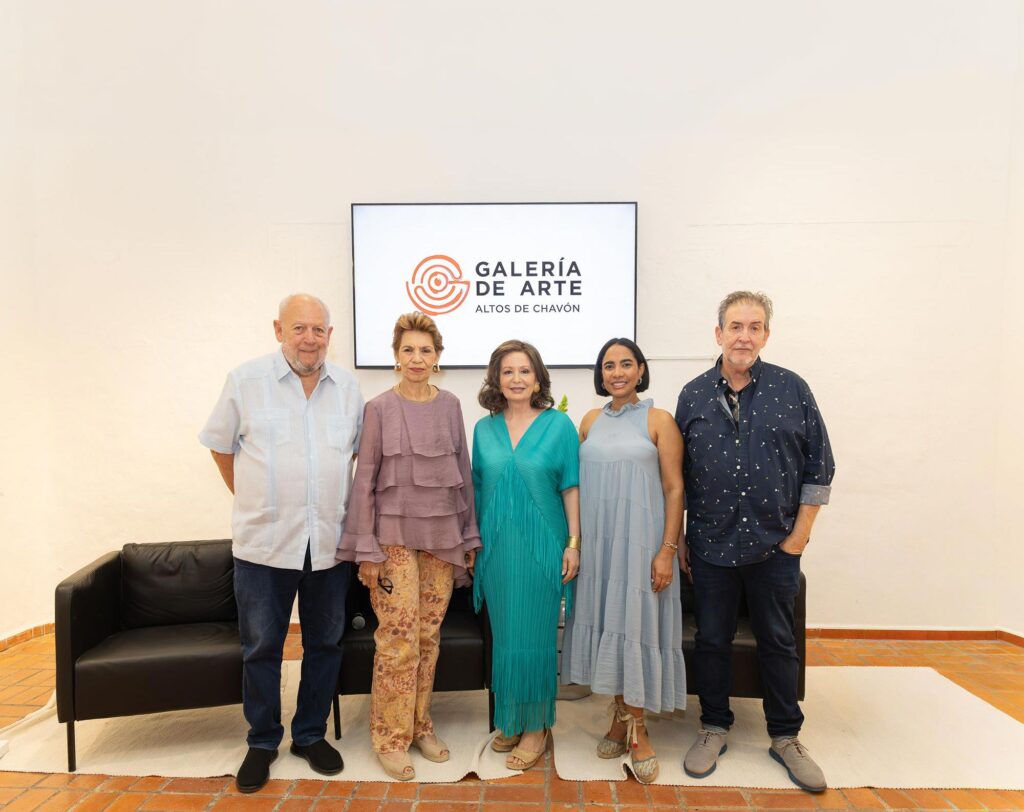
Laura Messina celebrated the official opening of her first solo exhibition on Saturday, November 7, featuring the series "Apeiros" and "Kintsugi," at the Altos de Chavón Art Gallery, Casa de Campo, La Romana, under the curatorship of art historian and critic Lilian Carrasco.
The exhibition brings together works created between 2025 and 2026 and explores transformation as a vital experience through a pictorial language based on abstraction, gesture, and experimentation with different materials.
The opening ceremony featured welcoming remarks by Marcela Pizarro, Manager of Altos de Chavón, followed by speeches from cultural managers María del Carmen Ossaye (Cachi) and Freddy Ginebra, as well as artist Luis Nova.
During the gathering, Laura Messina shared with attendees some reflections on her creative process and the conceptual foundations of both series. The activity also included a special raffle led by the artist, with the participation of her granddaughter Mariana Seliman Catrain, followed by a cocktail reception and a tour of the exhibition.
The proposal is articulated around two series whose conceptual approaches converge in a reflection on existence, memory, and processes of personal reconstruction. In both, the artist develops compositions characterized by undulating lines, organic structures, and chromatic relationships that suggest inner territories, displacements, and states of transformation.
In "Apeiros," a term associated with the notion of the limitless, Laura Messina explores the relationships between origin, matter, space, and infinity. Works such as "Mares interiores" (2025), "Insondable" (2026), and "Cartografía de lo ilimitado" (2026) propose a sensitive approach to immensity and to the processes of change that traverse human experience.
"In my work, each undulating line is a metaphor for the human journey," expresses the artist, referring to one of the recurring elements of her visual vocabulary.
For its part, the "Kintsugi" series takes as a reference the Japanese art of repairing ceramic pieces, whose philosophy recognizes the value of fractures as part of the history of objects. From this perspective, Messina addresses vulnerability and resilience through compositions that evoke fragmentation and the possibility of reconstruction.
Pieces such as "Eternal fragments I" and "Eternal fragments II" (2026), "Senderos de transformación" (2026), and "Fractured continuum II" (2026) delve into this symbolic dimension, where ruptures cease to be understood exclusively as losses and become testimonies of transformation.
In the "Kintsugi" series, cracks are not wounds that must be hidden; they are traces of our transformation, notes Messina.
The exhibition reveals a plastic investigation in which acrylic, oil, crayons, markers, and water converge on canvas. This diversity of resources allows the artist to build surfaces and compositions that articulate matter, movement, and emotion.
Beyond their conceptual differences, "Apeiros" and "Kintsugi" share the same concern: understanding transformation as a process inherent to existence. While the first series projects toward infinity and the territories of imagination, the second focuses on the traces of experience and the possibility of redefining them.
The exhibition, open to the public since October 24, will remain until November 21, 2026, at the Altos de Chavón Art Gallery, Casa de Campo, La Romana.